

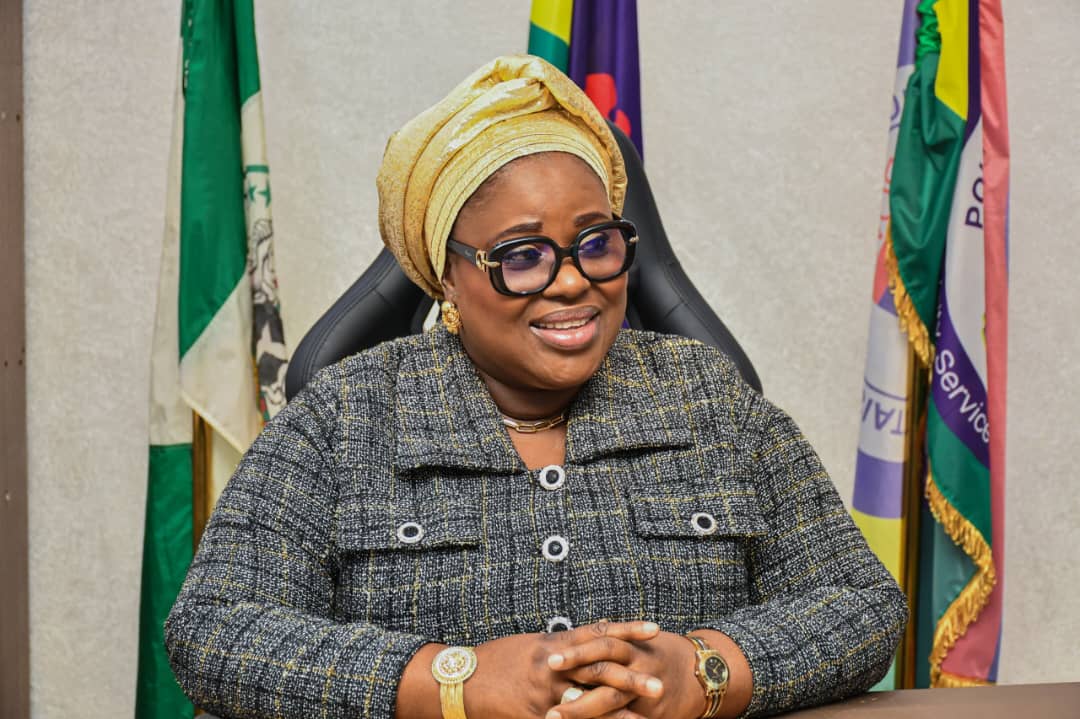

The President of the Police Officers’ Wives Association (POWA) and Wife Inspector-General of Police (IGP), Mrs. Olufunmilola Disu, has reaffirmed the critical link between national security and the welfare of police families, declaring that “a strong police force is built on the well-being of its families.”
She made this known on Tuesday, at the Lagos edition of the POWA CARES Initiative, a nationwide programme in collaboration with Lagos State Government aimed at improving the health, economic stability, and social welfare of police families.
Welcoming dignitaries, including representatives of the Inspector-General of Police, the Lagos State Government, senior police officers, healthcare professionals, and development partners, Mrs. Disu described the initiative as “a vision, not just an event.”
According to her, global evidence has shown that when families of security personnel are adequately supported, officers perform their duties with greater focus, dignity, and effectiveness.
She noted that the Lagos intervention builds on the success of the programme’s first phase in Abuja, where over 1,000 beneficiaries received eye care and medical support.
“In Lagos, we are scaling that vision,” she said.
Mrs. Disu disclosed that over the course of the two-day programme, more than 1,000 beneficiaries would receive free eye screening, treatment, corrective eyewear, dental care, and medical consultations.
Beyond healthcare, she explained that the initiative also targets education and economic empowerment through nursing scholarships and financial grants to 200 families, as well as the distribution of Cowry transport cards to ease mobility.
She further highlighted efforts to promote inclusion and recognition, noting that selected families would engage directly with top leadership, including the Inspector-General of Police and the Lagos State Governor“These engagements affirm that police families are seen, valued, and respected,” she said.
The POWA President also emphasized youth-focused interventions, including sensitisation on drug abuse, cultism, and sexual and reproductive health, aimed at safeguarding the next generation.
Describing the initiative as a shift from “isolated welfare gestures to a structured and sustainable social protection system,” Mrs. Disu said the programme is designed for replication across all states of the federation.
She expressed appreciation to Lagos State Governor Babajide Sanwo-Olu, First Lady Dr. Ibijoke Sanwo-Olu, and other partners for their support, as well as healthcare professionals whose contributions have driven the programme’s success.
Declaring the Lagos phase officially open, she reiterated:
“When we invest in families, we strengthen institutions and ultimately the nation.”
Speaking on behalf of the Inspector-General of Police, IGP Olatunji Rilwan Disu, Tijani Olaiwola Fatai described the POWA CARES Initiative as a “remarkable demonstration of compassion, service, and purposeful leadership.”
He noted that the programme underscores the Nigeria Police Force’s commitment to prioritising the welfare of its personnel and their families.
“The strength of any police organisation lies in the well-being of its personnel and their families. When officers are confident that their loved ones are cared for, they serve with greater commitment and dignity,” he said.
Fatai commended the expansion of the initiative to Lagos on a larger scale, highlighting its strong focus on education, empowerment, and youth development as key investments in the future.
He also expressed appreciation to Governor Babajide Sanwo-Olu, Dr. Ibijoke Sanwo-Olu, and other stakeholders for their continued support toward improving the welfare of police families in Lagos State.
The IGP’s representative further praised the leadership of POWA for sustaining the initiative, describing it as a noble effort that continues to inspire hope and positively impact lives across Nigeria.
He called for sustained collaboration among stakeholders to build a police institution that not only protects lives and property but also prioritises the well-being of those behind officers in uniform.