

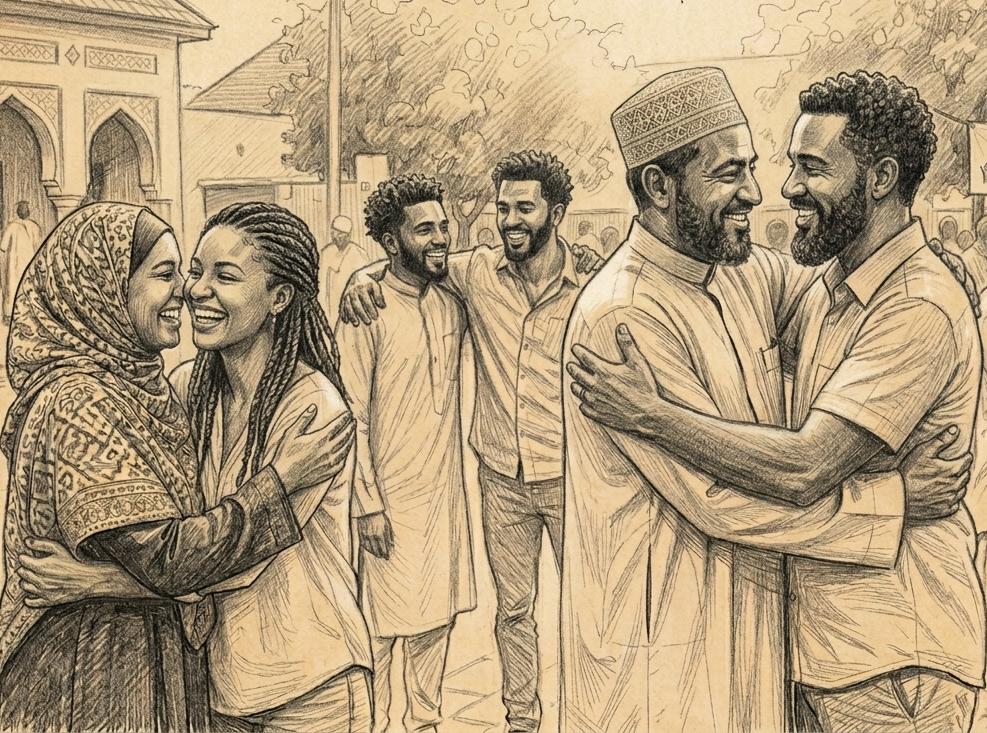
Islamic Scholar Advocates Permissibility of Greeting Non-Muslims with Salam
A member of the National Institute (mni) and official of the Directorate of Islamic Affairs, Nigerian Army, Abubakar Tahir, has presented a scholarly argument supporting the permissibility of Muslims greeting non-Muslims with the Islamic salutation, Assalamu alaikum, as part of efforts to promote peaceful coexistence in diverse societies.
In a presentation titled “The Permissibility of Greeting Non-Muslims with Salam: A Scholarly Perspective,” Tahir addressed longstanding theological debates surrounding the appropriateness of extending Islamic greetings to people of other faiths. He argued that such greetings, when accepted, are consistent with Islamic teachings on good conduct, mutual respect, and social harmony.
According to him, the issue goes beyond religious ritual and should be understood within the broader framework of human interaction and community relations. He noted that Islam encourages adherents to use kind and respectful language in all engagements, citing the Qur’anic injunction urging believers to “say to people that which is best.”
Drawing from historical and contemporary Islamic scholarship, Tahir explained that several companions of the Prophet Muhammad, including Abdullahi ibn Abbas, Abdullahi ibn Mas‘ud, and Abu Umamah al-Bahili, permitted the exchange of greetings with non-Muslims. He added that successors of the companions, such as Amir al-Sha‘bi and Umar ibn Abdul-Aziz, also supported this position, emphasising fairness and kindness in interpersonal relations.
The presentation further highlighted the views of classical scholars like al-Awza‘i and Sufyan ibn Uyaynah, who endorsed flexibility on the matter, as well as modern scholars including Rashid Rida and Yusuf al-Qaradawi, who framed the greeting as a gesture of goodwill in contemporary pluralistic societies.
Tahir explained that Qur’anic verses such as 60:8, which encourages kindness and justice toward those of other faiths who are not hostile, provide strong justification for the permissive stance. He also referenced the example of Prophet Ibrahim, who greeted his non-believing father with words of peace, as evidence of the broader Islamic ethos of peaceful engagement.
While acknowledging opposing views that cite prophetic traditions discouraging initiating greetings to non-Muslims, Tahir clarified that such narrations were context-specific, linked to periods of conflict, and should not be generalised to peaceful settings.
He stressed that in modern multi-faith societies like Nigeria, extending greetings—whether Islamic or conventional—can serve as a bridge for understanding and cooperation. Where Salam may not be appropriate or welcomed, he advised the use of neutral greetings such as “Good morning” or “Hello” to achieve the same purpose of fostering goodwill.
The scholar concluded that the permissive approach aligns with the objectives of Shari’ah, which prioritise harmony, justice, and positive human relations. He urged Muslims to act as ambassadors of peace, using both words and actions to strengthen unity and reduce tensions across religious divides.
By TimesNG