

NPRW Kaduna: How a Strategic PR Gathering Produced Multiple Events
By Mohammed Dahiru Lawal
The Nigeria Public Relations Week (NPRW)—the evolved form of the annual conference of the Nigerian Institute of Public Relations (NIPR)—has, in just three years, grown from a professional gathering into a national instrument of policy engagement and narrative shaping.
From its debut in Ogun State under the banner of economic and reputation renaissance to its expansion in Akwa Ibom with a focus on solid minerals and economic recovery, NPRW has consistently sought to convene leaders across government, business, academia, civil society, and the media. Yet, Kaduna 2026 has elevated that ambition into something more deliberate—more strategic.
Like previous editions, I had not planned to attend. That changed when the Kaduna State Commissioner for Information, Ahmed Maiyaki, extended what can only be described as an irresistible invitation.
“Come and see the greatest event of the year,” he said—backing his confidence with full logistical support.
As a journalist, fact-checker, and public relations practitioner, curiosity demanded that I take him at his word.
What I encountered in Kaduna—“Croc City”—was not merely an event, but a carefully orchestrated sequence of engagements that blurred the lines between conference, policy dialogue, media exposure, and governance showcase.
The itinerary itself raised legitimate doubts. A youth forum, media tours across the state, high-level policy sessions, an investiture ceremony, and a media chat with Governor Uba Sani—all within a compressed timeline. It appeared overly ambitious.
Yet, from the moment proceedings began, it became clear that the ambition was intentional.
My first engagement came unexpectedly at Kaduna State University, where I was drafted into a panel at the Kaduna Youth Forum. The session—focused on youth vulnerability and substance abuse—provided not just a platform for discussion, but a window into an underreported aspect of Kaduna’s governance response.
Sharing that stage with Deputy Governor Hadiza Sabuwa Balarabe was instructive. Beyond symbolism, her presence reflected a government attempting to address social challenges through institutional frameworks. The establishment of the Kaduna State Bureau for Substance Abuse Prevention and Treatment stood out as a notable departure from the conventional reliance on enforcement alone. By combining rehabilitation, awareness, and community engagement, the state has reframed addiction as a public health and governance issue.
The subsequent media tour reinforced a recurring theme: that governance, when properly communicated, becomes more visible—and perhaps more credible.
At the Kaduna State Security Command and Control Centre, the scale of investment in intelligence-led security became evident. With over 228 CCTV cameras across strategic locations and an extensive fibre optic backbone, the system integrates real-time monitoring, drone surveillance, and inter-agency coordination. Facilities like the Kaduna Incident Report Centre and collaboration with the Kaduna State Vigilance Service underscore an attempt to institutionalise security beyond reactive measures.
But security, as the tour revealed, is only one layer of the administration’s broader governance approach.
At the Kaduna State Institute of Vocational Training and Skills Development, Provost Husaini Haruna Muhammad outlined a model anchored on practical competence rather than theoretical certification. With thousands of trainees already enrolled and ambitious graduation targets, the initiative reflects a policy shift toward employability-driven education.
A similar transformation is unfolding in the formal education sector. At Government Secondary School, Nasarawan Rigachikun, Permanent Secretary Rabi’u Yunusa detailed ongoing reforms—over 100 schools under renovation, thousands of teachers recruited and trained, and hundreds of thousands of out-of-school children reintegrated into classrooms.
Infrastructure development tells its own story. More than 140 road projects spanning over 1,300 kilometres have been initiated or completed, including the long-neglected Sokoto Road. In the media sector, the digitisation of the Kaduna State Media Corporation, supported by Nigerian Communications Satellite, has expanded the state’s broadcast reach beyond Nigeria into regional and international spaces.
On transparency, Kaduna’s engagement with the Open Government Partnership signals a commitment—at least in intent—to accountability and citizen access to information.
Economically, the figures are equally striking: investments exceeding $743 million actualised within two years, with a pipeline surpassing $3.5 billion.
Agriculture, in particular, has seen exponential budgetary growth, alongside fertiliser distribution, crop insurance schemes, and the development of Special Agro-Industrial Processing Zones.
Yet, it was the policy conversations during the latter part of the week that gave NPRW 2026 its intellectual depth.
The keynote address by Brylyne Chitsunge reframed agriculture not merely as an economic sector, but as a communication challenge. Her argument—that inclusive communication is foundational to agricultural transformation—resonated across sessions. Women and youth, she noted, remain excluded not only by policy gaps but by the narratives that define the sector.
This perspective was echoed during the ministerial dialogue featuring Mohammed Idris, Abubakar Kyari, and Idi Mukhtar Maiha. Their consensus was clear: policy effectiveness depends as much on communication as on design. Innovation in agriculture exists—but remains largely invisible due to weak communication frameworks.
The Governor’s Solutions Roundtable brought these ideas into sharper focus. Kaduna’s agricultural interventions—ranging from fertiliser distribution to support for tens of thousands of farmers—demonstrated an attempt to translate policy into tangible outcomes. The emphasis on value chains and agro-industrial zones suggests a shift from subsistence to structured agribusiness.
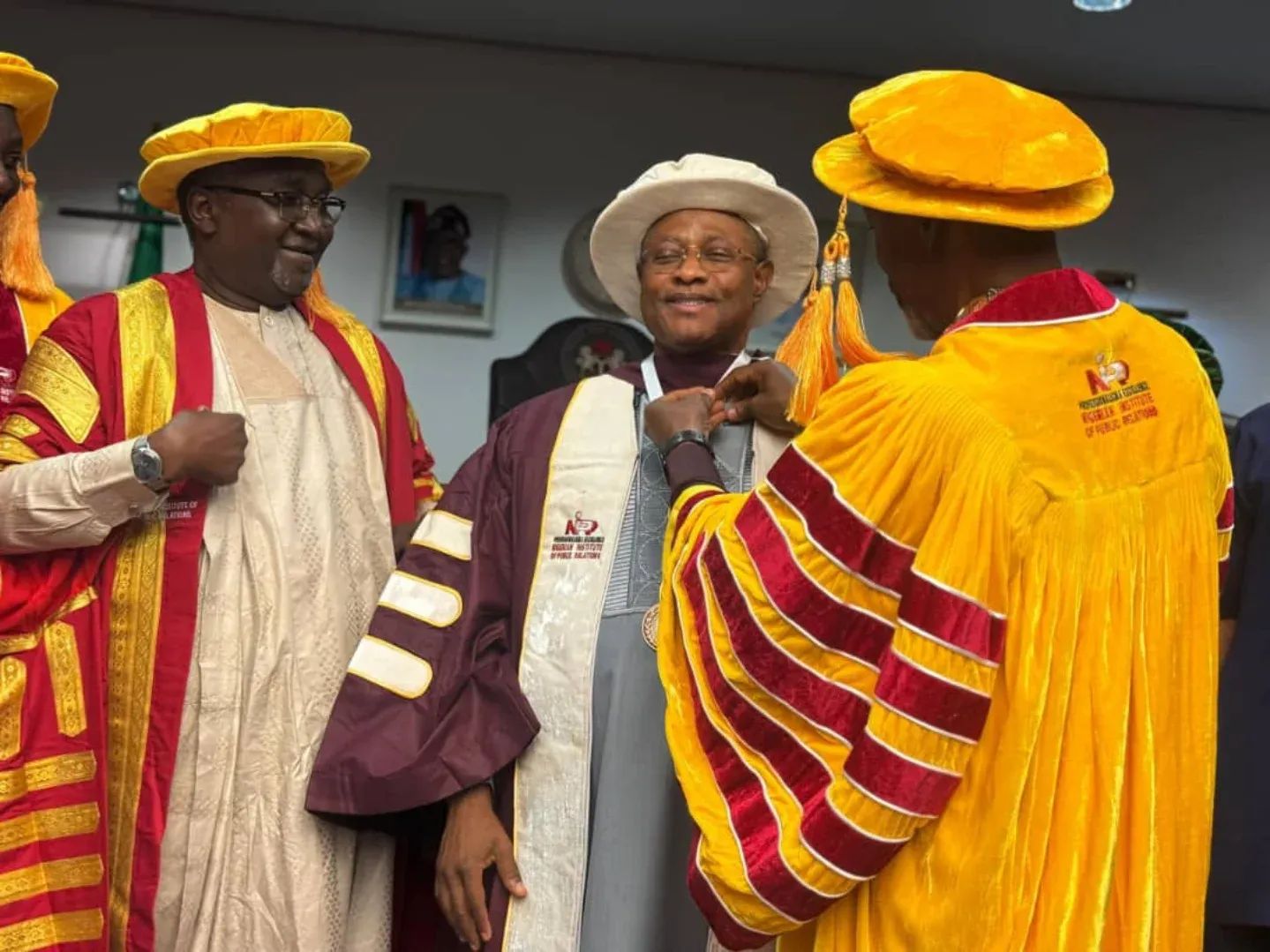
The climax of the week, however, was the investiture of Governor Uba Sani.
In a rare triple honour, the NIPR conferred on him an Honorary Fellowship, designated him Grand Patron, and appointed him Ambassador of the World Public Relations Forum. The ceremony, led by NIPR President Ike Neliaku, doubled as the commissioning of the renovated Brigadier Abba Kyari Banquet Hall at Government House—an example of how a single event can serve multiple strategic purposes.
Dignitaries in attendance included Vice President Kashim Shettima, former governors Ramalan Yero and Namadi Sambo, and the Emir of Zazzau, Ahmed Nuhu Bamalli. Media and communication leaders such as Raymond Dokpesi Jr., Alhassan Yahya Abdullahi, Tony Akiotu, and Jibrin Baba Ndace were also present, alongside international figures like Arik Karani.
What Kaduna achieved with NPRW 2026 was not accidental. It demonstrated that public relations events, when strategically designed, are not mere gatherings—they are instruments. They can commission projects, shape narratives, build legitimacy, and reposition governance in the public mind.
By the time the curtains fell, NPRW 2026 had done more than host conversations. It had created visibility for policies, provided context for governance, and offered a template for how communication can intersect with development.
Whether future editions will surpass Kaduna’s benchmark remains uncertain.
But for now, one conclusion is difficult to contest: NPRW Kaduna was not just the greatest event of the year—it was a masterclass in how communication, when properly deployed, can become governance in motion.
Mohammed Dahiru Lawal is the Head of Fact-Checking and Special Projects at TimesNG. He can be reached at [email protected].