

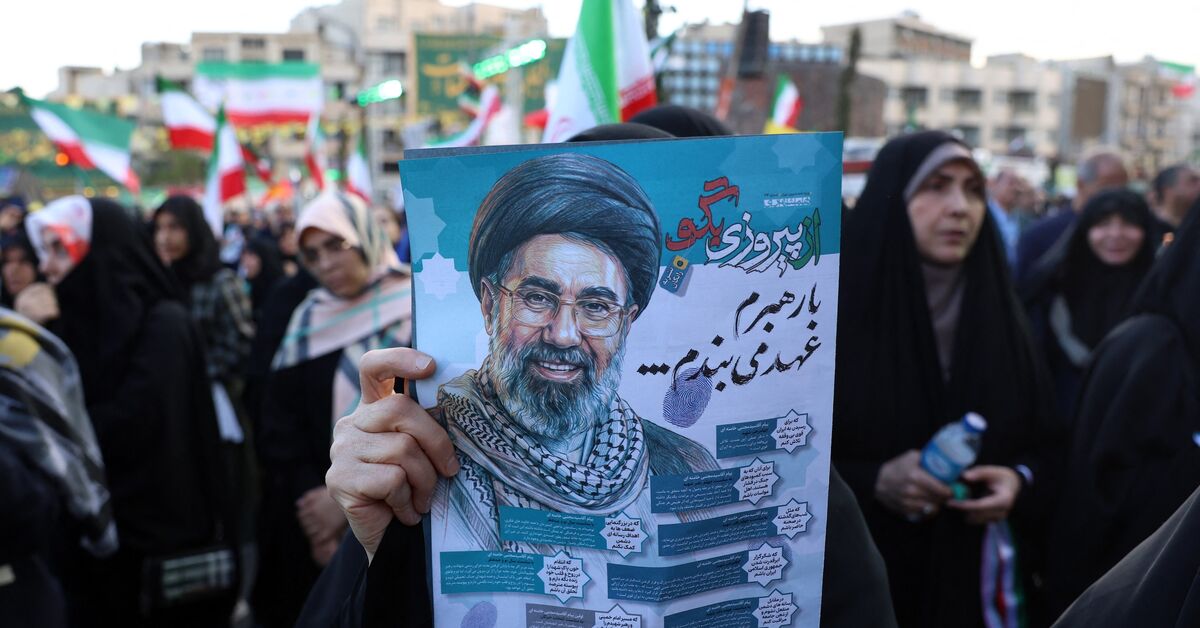
Iranian Supreme Leader Ayatollah Ali Khamenei appealed to Gulf states and chastised the United States in a written statement on Thursday, pledging to protect the Strait of Hormuz and end the American presence in the region.
Khamenei’s written address on the occasion of Persian Gulf National Day in Iran was his third since succeeding his father, Ali Khamenei, last month. Khamenei has yet to appear in public since being declared supreme leader and was reportedly severely injured in the US-Israeli strike that killed his father at the start of the war.
The new supreme leader said Iran seeks to expel the US from the Gulf, declaring, “The bright future of the Persian Gulf region will be one without the United States — dedicated to the progress, comfort and prosperity of its nations.” He appealed to Arab states in the region, saying they share a “common destiny” with Iran.
“We and our neighbors along the Persian Gulf and the Sea of Oman share a common destiny,” he said in the statement carried by state media. “Outsiders who come from thousands of kilometers away with greedy intentions have no place here except in the depths of its waters.”
Khamenei touted “Iran’s new management of the Strait of Hormuz” as well as a “corresponding legal framework” that he said would benefit the region. Iran began restricting ships from passing through Hormuz without permission in early March, leading the US to impose a blockade on Iran. Only about seven ships a day are passing through as a result, down from around 130 per day before the war. Iran is reportedly restricting transit to vessels from friendly nations and may be imposing fees on passage, while the United States is enforcing a blockade that prevents ships, especially those involved in the oil trade, from accessing Iranian ports.
Iran’s new management of the Strait of Hormuz and the corresponding legal framework will secure comfort and progress for the benefit of all the nations of the region.
— Ayatollah Mojtaba Khamenei (@MKhamenei_ir) April 30, 2026
Iran carried out thousands of strikes targeting Gulf states after the US and Israel began their campaign against the Islamic Republic, hitting not only sites hosting American forces but energy facilities, airports and other civilian targets. The US has troops in every Gulf Cooperation Council state, with a total of roughly 50,000 service members in the region. Iran has long sought to expel American forces from the Middle East.
The strikes prompted widespread anger in the Gulf, and Emirati Assistant Minister of Foreign Affairs Abdulla Balalaa slammed Iran in an interview with Al-Monitor last week for striking near desalination infrastructure. He said that the Strait of Hormuz should reopen as part of any deal.
Lines of communication between Iran and some Gulf states remain open, and Foreign Minister Abbas Araghchi held calls with his Saudi and Qatari counterparts on Sunday.
A ceasefire in the US-Israel-Iran war took effect on April 8.
Nuclear, missile technology ‘national assets’
Khamenei vowed that Iran would retain its capabilities with regard to nuclear energy and missiles. He said Tehran sees “nuclear and missile technologies” as “national assets” and that its military forces “will safeguard them just as they defend their land, sea and air borders.”
US President Donald Trump has demanded a new agreement with Iran that addresses not only the country’s nuclear program, but its ballistic missiles and support for regional proxies.
“Iran can’t get their act together. They don’t know how to sign a nonnuclear deal. They better get smart soon!” Trump wrote on Truth Social Wednesday, posting an AI-generated picture of himself holding a machine gun.
Appeal to international community
The IRGC released a statement on Thursday saying that the US blockade punishes China, Russia and Europe in addition to Iran.
“The Trump administration shifted from a strategy of managing global energy to one of disruption, and the naval blockade began as part of a grand disruption project to contain China, Russia and Europe,” said the IRGC. “However, 20 days later, the White House is increasingly convinced the project has failed and Tehran has emerged as the center of an anti-disruption coalition.”
The strait is vital to the global supply chain and typically services around a fifth of global oil exports. The price of Brent crude oil surged above $120 a barrel on Wednesday as the disruptions take their toll on the global economy.
Iranian President Massoud Pezeshkian said on Thursday that “Iran is ready to continue diplomacy if US maximalist approach stops” on a call with Japanese Prime Minister Sanae Takaichi, the official Islamic Republic News Agency reported.
The US and Iran last held negotiations in Pakistan on April 11. A planned trip to Pakistan by US Vice President JD Vance fell through last week and the two sides have not engaged in direct talks since.