

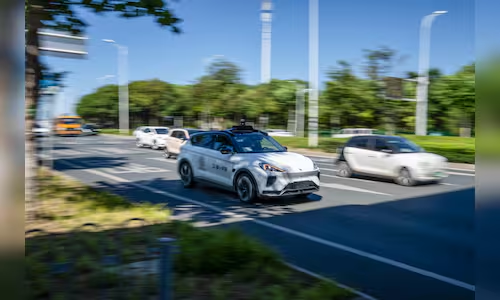
The incident alarmed authorities, and three agencies including the Ministry of Industry and Information Technology convened a meeting earlier this month with officials from cities that have robotaxis or autonomous-driving pilots, the people said. Regulators called for local governments to conduct a full self-review and enhance safety monitoring to prevent similar incidents, said the people, who declined to be identified because they aren’t authorized to speak publicly.
The suspension of new licenses prevents self-driving companies from adding new robotaxis to their fleets, starting a new test project or expanding to a new city, the people said. It’s not clear how long the suspension will last, the people said.
Baidu shares fell as much as 3.9% in Hong Kong trading Wednesday. Rival robotaxi providers Pony AI Inc. and WeRide Inc. both declined around 2%.
The halt comes as a setback to a fast-growing industry that is estimated to be worth 83.1 billion yuan ($12.2 billion) by 2030, according to analysis by Soochow Securities. Chinese companies are on the forefront of bringing the technology to global markets, locked in competition with rivals such as Alphabet Inc.’s Waymo in the US.
This marks at least the second time that regulators have paused new permits due to a Baidu-related incident.
In the Wuhan incident, more than 100 Apollo Go robotaxis stalled on city streets on March 31, according to Chinese media reports. Local police said the outage was likely caused by a systems fault, although Baidu has yet to comment on the cause. Apollo Go is the largest robotaxi provider in China, with hundreds of vehicles in more than a dozen cities.
Baidu’s Wuhan robotaxi operations have also been suspended while local authorities investigate the incident, the people said.
MIIT, the Ministry of Public Security and the Ministry of Transportation didn’t reply to faxed requests for comment. A representative for Baidu didn’t immediately respond to emailed questions.
Pony AI said its services in Beijing, Shanghai, Guangzhou and Shenzhen are currently operating normally. And preparation for Changsha and Hangzhou is progressing as planned, a spokesperson said. WeRide said it supported authorities’ efforts to ensure the highest safety standards across the industry, and that their services in China are still operating as normal.
Beijing is trying to balance safety concerns and negative public sentiment over AI-related job losses with the desire to groom homegrown technology in the autonomous-driving race against the US.
The licenses specifically pertain to level four autonomous driving vehicles, which refers to a high degree of driving automation where a human doesn’t need to intervene.
Two years ago, residents in Wuhan protested over the deployment of Apollo Go robotaxis in the city, fearing taxi drivers could lose their jobs. To calm public sentiment, regulators froze approvals in late 2024 for several months and it wasn’t until early 2025 that permitting resumed.
The shares of China’s two US-listed robotaxi companies have fallen this year, with WeRide down almost 10% and Pony AI plunging around 30%. The companies are yet to make a profit and need to invest heavily into developing new products and supporting their global expansion plans.